

Most buyer’s agents don’t know seller concession caps. The ones who do sometimes negotiate past them anyway. When that happens, the surplus doesn’t go to the buyer. It goes back to the seller for free.
What is a seller concession?
A seller concession is when the seller agrees to pay a portion of the buyer’s closing costs, or repair costs instead of the buyer covering those out of pocket. It’s not a price reduction, it’s a redirect of who pays what at closing.
Why Buyers Need Them:
Most buyers are already maxed out on their down payment. They scrape together 10–20% to hit the mortgage qualification, and they’re tapped. Closing costs can run 2–5% of the purchase price. That’s $6,000–$15,000 on a $300k home that they may not have sitting around. A seller concession fills that gap so the buyer can actually close.
Lenders directly state to their buyer clients and the buyer’s agent that in order for them to buy a house seller concessions must be negotiated into the deal.
Why Sellers Offer Them:
Early in the transaction to move the needle on price without cutting the asking price.
Seller is at $300k asking. Buyer offers $290k with no concessions. Seller counters: $299k with 3% seller concession. The seller effectively got closer to the list price and the buyer feels like they won. Everyone’s happy, and the sale closes.
2. Late in the transaction to avoid repairs.
Inspections in New Orleans can find foundation cracks, roof issues, sewer line issues or HVAC challenges. All fairly normal.
Repairing this is less than ideal for a home seller. Sellers do not normally have thousands of dollars to fix, they could be out of town, or just don’t want to deal with contractors. Instead of a repair, they usually offer the buyer a closing cost concession. Buyer uses that savings to hire their own contractor post-closing and fix it their way. Seller avoids the repair obligation entirely.
3. Just to make the deal work
In a soft market, a seller might need to offer concessions just to close a deal. The buyer can afford the house but not the closing costs. Seller has two choices: cut the price or offer concessions. Smart sellers run the math on net proceeds either way. Sometimes concessions hurt less than a price cut.
How much can I negotiate for?
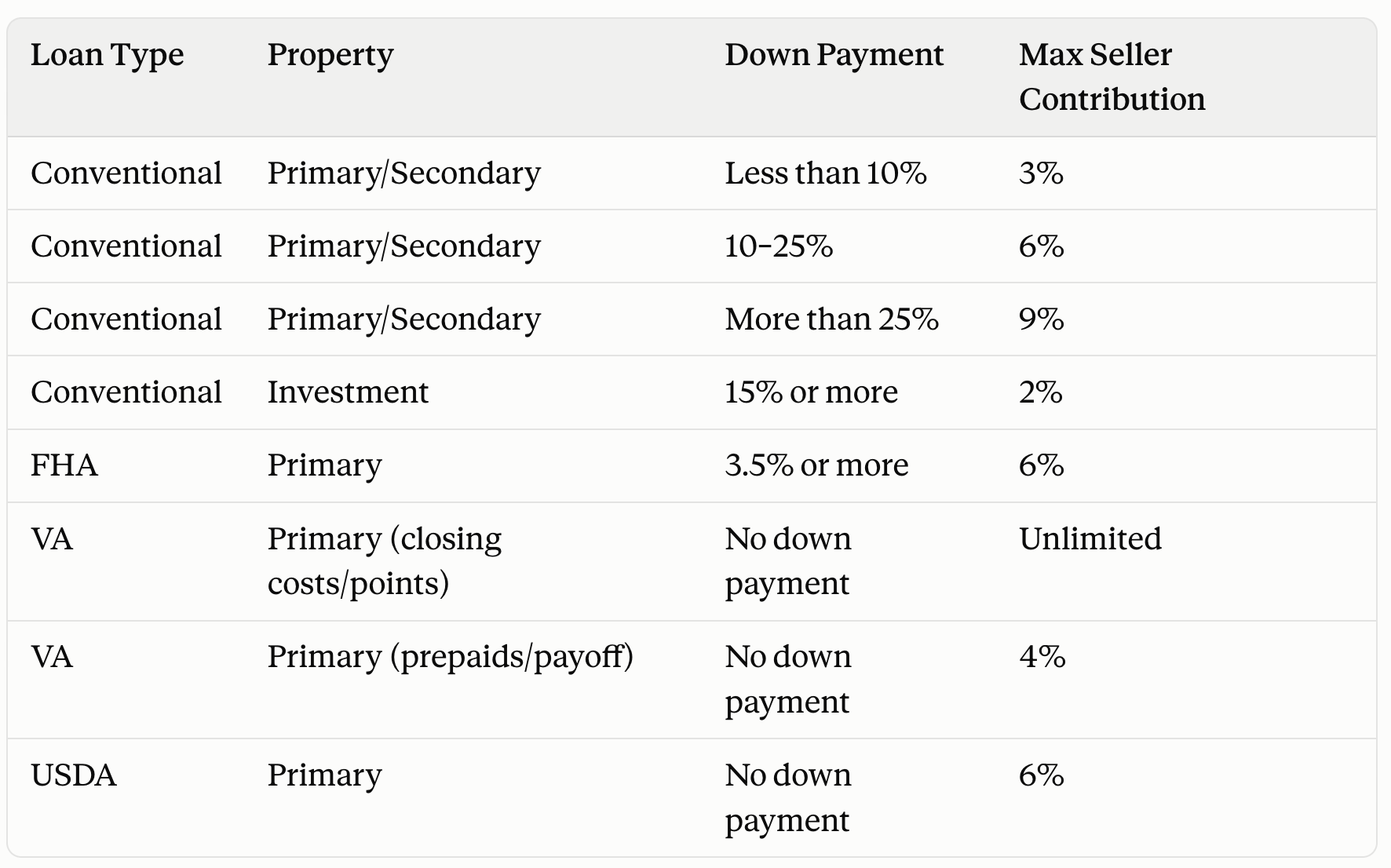
Each loan type offers a unique max seller contribution. For conventional the number rises significantly based on the buyer’s down payment amount.
Here’s Where It Gets Tricky (And Where Agents Mess Up):
Every loan type has a maximum seller concession allowed. Conventional 10% down? 3% cap. FHA? 6% cap. VA? Unlimited.
The problem: A lot of agents don’t know these limits. Or they know them and negotiate past them anyway.
When a buyer’s agent asks for $12,000 in seller concessions on a $300k home (4%), but the buyer’s conventional loan with 10% down only allows 3% ($9,000), the extra $3,000 can’t legally go to the buyer. It goes back to the seller at closing.
The seller suddenly gets an unexpected $3,000 credit.
The Real Move:
If concessions get negotiated past the limit, the buyer’s agent needs to know this before closing and redirect the surplus.
I represented a condo sale earlier this month where the buyer’s agent negotiated 4% in seller concessions. His loan only allowed 3%. That extra 1% was dead money until we redirected it to HOA dues. The buyer’s agent knew he had to use it or lose it.
Know your loan’s concession cap before you negotiate. If your agent asks for more than allowed, that’s a red flag. Either they don’t know the limit or they’re not checking it. Either way, ask them why.
Philip Ewbank,
Realtor Keller | Williams Realty New Orleans | 504.335.7481