

Early voting runs through Oct 27, closed Sunday Oct 25. Election Day is Nov 3.
Early voting started yesterday morning. Most people will reach the bottom of the ballot, see 10 constitutional amendments written in legislative language, and either skip them or vote no on all of them.
And that’s not guessing! Louisiana voters rejected every amendment in the last two elections, and the pollsters quoted in the Advocate this week think it could happen again.
I don’t have a position on how you should vote, but six of these amendments affect property taxes, homeownership or blight, and those are things I get asked about every week. So I read the bills and the legislature’s fiscal notes, and here’s what’s actually on the ballot.
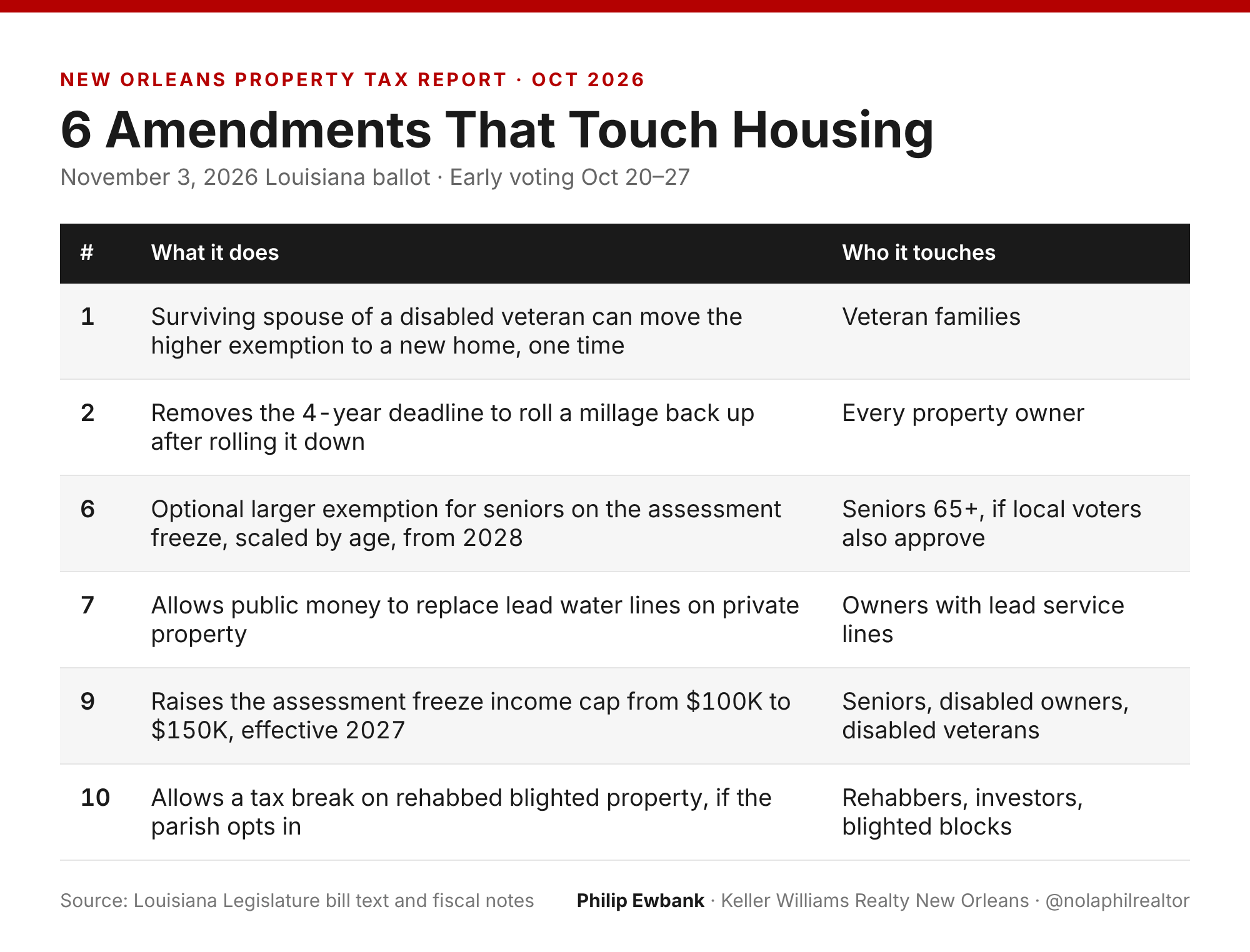
Amendment 2 : The Biggest Deal
When reassessment pushes property values up, every local taxing body faces a choice. It can roll its millage back so it collects the same dollars, or roll forward and keep the higher rate and the extra revenue.
Today there’s a clock on that choice. If a government rolls back and doesn’t roll forward within four years, the lower rate becomes permanent. Amendment 2 removes the clock. Local governments could roll forward any time during the millage’s voter-approved term, without a new election.
It doesn’t raise anyone’s taxes automatically. Supporters say the deadline creates a perverse incentive: governments roll forward early just so they don’t lose authority they might need later. Opponents say the deadline is one of the few guardrails homeowners have against rates creeping back up.
This is the only housing amendment that touches every property owner in every parish.
Amendments 6 and 9 : The One for Seniors
These two work together.
Amendment 9 expands who qualifies for the assessment freeze. That’s the program that locks the assessed value of a home for seniors, permanently disabled owners and disabled veterans. The income cap goes from $100,000 to $150,000, effective 2027, with inflation adjustments starting in 2028.
Amendment 6 lets parishes and cities give seniors on that freeze a larger homestead exemption, scaled by age.
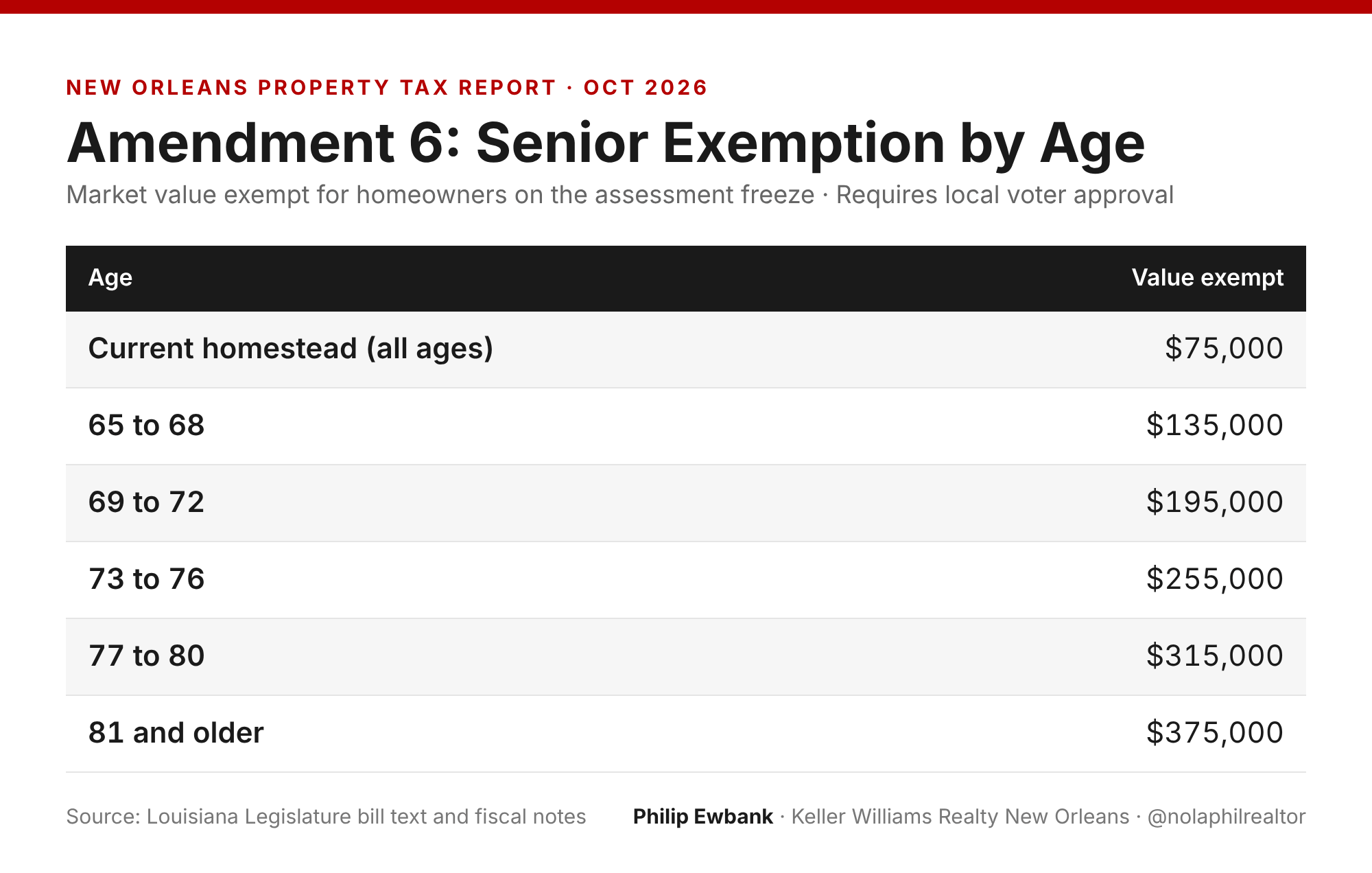
Two details matter more than the numbers. First, Amendment 6 does nothing until local voters approve it a second time, parish by parish. Second, both amendments require the taxing body to absorb the lost revenue. It can’t be pushed onto other owners through a millage adjustment.
Supporters say retirees on fixed incomes are being taxed out of homes they paid off years ago. Opponents say the lost revenue squeezes the local budgets that pay for police, fire, schools and drainage.
Amendment 10 : The Investor One
If it passes, parishes can choose to offer a tax break on blighted or derelict property after it’s been rehabbed. For residential property the cap is 75% of assessed value for up to 20 years. Each parish that opts in sets its own rehab standards, application process and approval rules.
Supporters frame it as a carrot after years of fines and liens that haven’t fixed the problem. Opponents, including the nonpartisan Public Affairs Research Council, question whether the break actually changes who rehabs, or just rewards projects that would have happened anyway.
For New Orleans, the real question comes after Nov. 3: whether the city opts in, and how strict its standards are.
Amendment 7 : The New Orleans One
Federal rules require lead service lines to be replaced by 2037. Amendment 7 explicitly allows public money to pay for the portion on private property. New Orleans’ replacement program is the main reason it’s on the ballot.
The attorney general has already issued an opinion saying the city can do this. Supporters call the amendment legal insurance. Opponents call it unnecessary.
Amendment 1 is narrow. The surviving spouse of a disabled veteran can move once without losing the higher exemption.
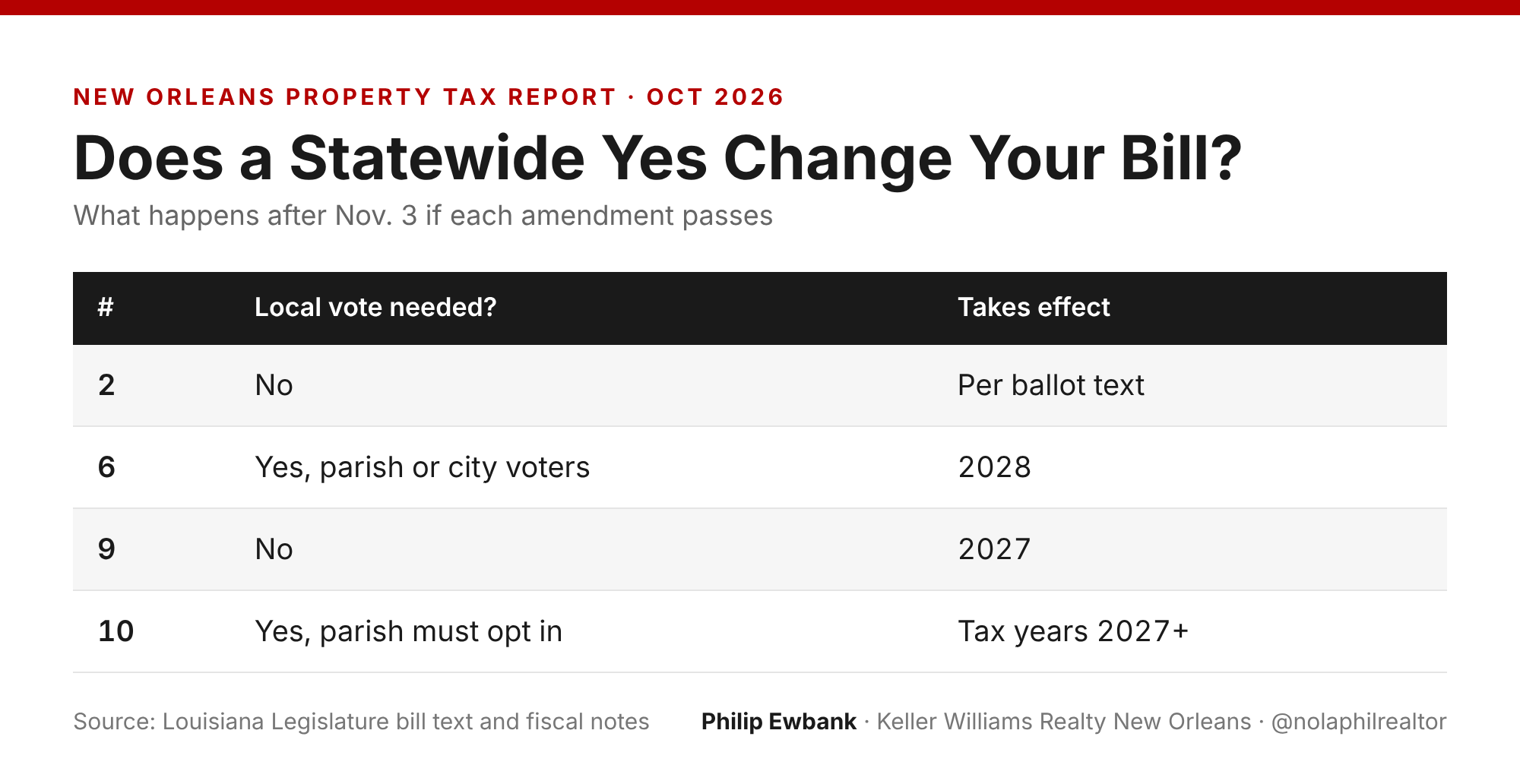
So...
If you own a home anywhere in the state, Amendment 2 is the one to read closely. It changes how your tax rate can move between elections.
If you’re 65 or older, or helping a parent who is, Amendments 6 and 9 are worth a look. Remember that a statewide yes on 6 is only step one.
If you rehab properties or own near blight, Amendment 10 is the one to watch, and the city council vote afterward matters more than the ballot itself.
And if you’ve already decided to vote no on everything, that’s your call. Just know what you’re voting no on.
Do you know whether your parish rolled back or rolled forward after the last reassessment?
🏠🏠🏠🏠🏠🏠🏠
Philip Ewbank, Realtor | Keller Williams Realty New Orleans
8601 Leake Ave, New Orleans, LA 70118
C: 504.335.7481 | O: 504.862.0100
Each office independently owned & operated. Licensed in the state of Louisiana. License #0995700196
Sources
The last time these measures were on the ballot they were all struck down. I think each needs careful consideration individually.
Should a surviving spouse retain Veteran’s benefits?
Should developers receive a tax incentive to improve blighted property?
Should we provide more property tax freezes for the elderly?
Don’t just blanket vote… research!